
StellaIQ builds an AI brain for your distribution business. It connects to the systems you already run — your ERP or stock control, your CRM, Xero or Sage, and the shared inbox — and puts an agent on every PC. Is that part in stock? When is it due in? What did we quote them? Have they got credit? Ask, and the answer comes straight back from your own data.
Because the answer is in four systems.
A customer rings and asks whether something is in stock. The stock figure is in the ERP, the delivery date is in a supplier's email, the last quote is in the CRM and the credit limit is in Xero. So someone checks the system, someone rings the warehouse, someone asks accounts — and the customer waits, or gets a guess.
A wholesaler doing £5m with fifteen staff usually runs an ERP bought years ago, an accounting package, a shared mailbox and a great deal of Excel. Each one works. Nothing passes anything to anything else, so people do the passing, and the business's knowledge ends up in a few people's heads.
None of that is a technology failure. It is the cost of growing faster than the systems did, and it is paid every single day in hours that nobody has budgeted for.
One brain connected to every system you run, and an agent on every PC that can ask it anything.
The brain stays connected to your systems and joins up what they hold — orders, stock movements, purchase orders, quotes, invoices and emails. Where a system allows live access it reads it live; where it only produces exports, it refreshes on a schedule you choose. Anyone can ask the agent on their PC a question in plain English and get the answer, with the record it came from. It only answers from your own data, and when it cannot find something it says so rather than guessing.
38 in the main warehouse and 12 at the trade counter. 30 are already allocated to open orders.
On purchase order PO-20931, confirmed by the supplier for Thursday 2 October.
£4,180 on 12 September, valid until 12 October. They have not replied yet.
£2,300 available on a £10,000 limit. One invoice is fourteen days overdue.
Example questions and answers. Your agent answers from your own systems.
The agents also take work off your team: they read and reply to routine customer emails in your own tone of voice, file what comes in, and draft the chaser for an overdue invoice for someone to check and send. See how the AI brain works →
Builders’ merchants and plumbing and heating merchants: your counter staff ask what is in stock and when it is due, and the answer comes straight from Sage 200.
At a merchant the question comes across the counter or down the phone all day: have we got it, which branch has it, and if not, when is it due in? Usually that means looking up the stock in Sage 200, opening the purchase order, then ringing the buyer or the supplier to check the date. StellaIQ connects the AI brain to Sage 200 and reads the free stock in each warehouse, what is already allocated to open orders, and the purchase orders with their due dates. Whoever is on the counter asks the question on their PC and gets the answer in seconds, with the purchase order it came from.
It reads Sage 200 and never changes it. Depending on your version and where it is hosted, we connect through the Sage 200 API or read-only database views, and the brain can also read the supplier emails that confirm or move a delivery date. The first step is the two-day operations audit at £2,500 plus VAT, which shows exactly what it would take on your setup.
Most of what is sold as AI is automation with a better name, and the distinction matters because it changes what you should pay and what you should trust.
Reconciling a supplier statement is arithmetic. Applying a customer's agreed terms is a rule. Flagging stock below its reorder point is a comparison. Optimising a delivery round is a calculation. None of those need a language model, and putting one in front of them makes the job slower, more expensive and less certain — because rules are instant, cheap, auditable, and incapable of inventing an answer.
AI earns its place somewhere narrower: reading messy documents that arrive in forty different layouts, answering a question from your own material, and turning a day of exceptions into something a human can read in two minutes. We tell you which of your problems is which, and we do not sell you the expensive one when the cheap one works.
A simple question, and in most distribution businesses the answer is split across the CRM, the sales spreadsheet, the accounts and someone’s inbox. This is what it looks like when you ask it once, in plain English, and get the answer in seconds — every line traceable to the record it came from.
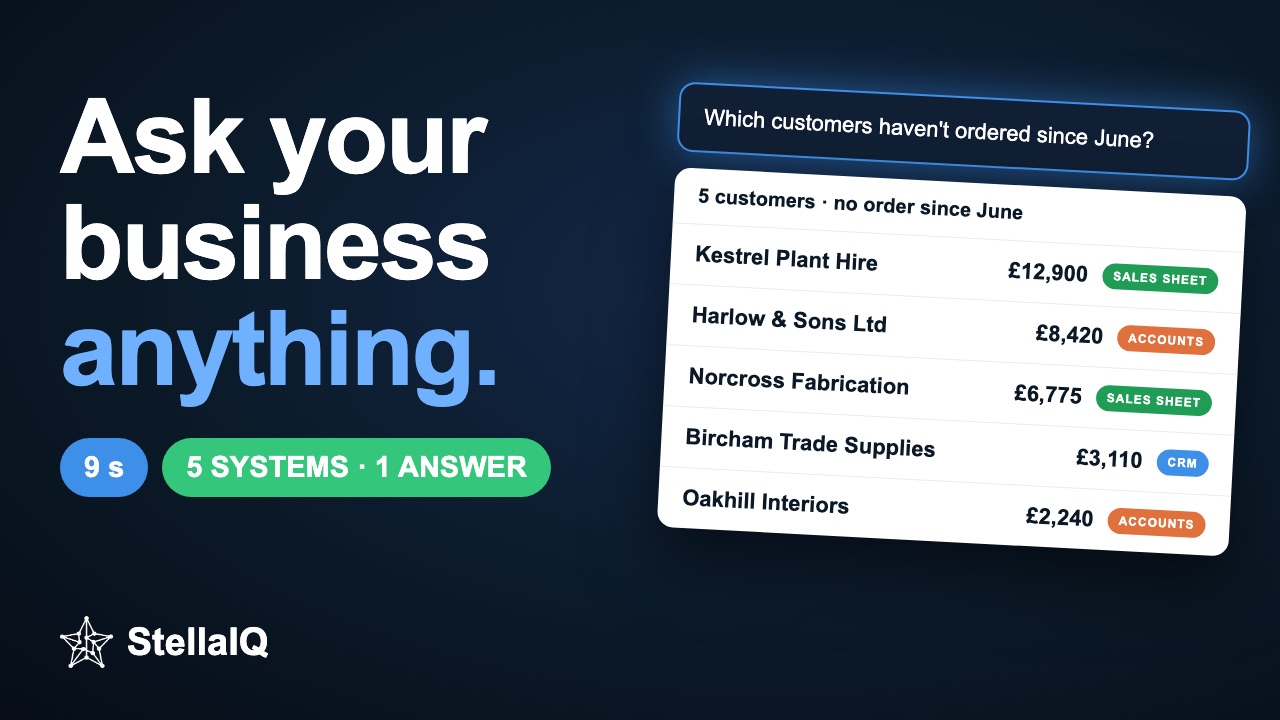
Screens illustrative; names and figures are examples. Plays from YouTube in privacy-enhanced mode, only when you press play.
The brain goes in first, connected to the accounts mailbox, the bank, the accounts package and the stock system. Then it takes jobs off your team one at a time, starting with the money. Each job is tested on your own documents and runs beside the way you work now until the two agree, and once the brain is doing it, anyone can ask about it from their PC.
The brain reads every supplier invoice as it lands in the accounts mailbox and matches it to its purchase order in your stock system, checking the price, the quantity and any part delivery. Each one is marked as matched, needing attention or having no purchase order, so a person only looks at the exceptions.
Ask it: “Which invoices are still waiting on a purchase order?”
Statements arrive as PDFs, spreadsheets and email bodies. The brain checks each one against the invoices and payments it already holds on the day it arrives, and lists the differences: an invoice you never received, a duplicate, a credit not yet applied.
Ask it: “What doesn’t agree on this month’s statement?”
By eight every working day the brain sets out what is due under terms, which settlement discounts are available and until when, what is overdue, which suppliers are close to putting you on stop, the cash in the bank that morning, and a recommended payment run. A person approves it and makes the payments; the brain records who approved what and marks the invoices paid once the money has gone.
Ask it: “Who do we have to pay this week, and what discount do we lose if we wait?”
The brain matches receipts from the bank and your card providers to your sales invoices, including card settlements that cover several customers at once, less the fee. Monthly customer statements and reminders at seven, fourteen and twenty-one days go out in your own wording, any customer can be held back, and your bookkeeper gets the allocations in the format they already use.
Ask it: “Has that customer paid, and what’s still open on their account?”
The brain reads fines, whether scanned, photographed or emailed, and matches each one to the van and the driver. It adds out-of-hours use from the tracker and fuel from the fuel card, giving one statement per driver each month for you to approve, and drafts a challenge for every fine, with each deadline tracked.
Ask it: “Who had the van when that fine was issued?”
Once the money side is running, the same brain moves on: reorder points worked out from real sales and supplier lead times rather than a number set years ago, trade orders read from email and PDF and raised without retyping, and delivery paperwork filed against the right job, with only the exceptions sent to a person.
Ask it: “What do we need to reorder this week?”
What the brain never does. It pays nobody: its access to your bank and accounts is read-only, and a person makes every payment. It does not post to your accounts package, so your bookkeeper carries on as now. It does not change a supplier’s terms, and it deducts nothing from anyone’s pay. It shows, and a person decides.
Yes, and that is deliberate. Replacing an ERP in a £1m–£20m distributor is a six-figure project with a year of disruption attached. Automating around one is a fixed-price build measured in weeks. We would rather find out how much of the manual work disappears without touching the core system, and we will say so plainly if the honest answer is that the ERP itself is the constraint.
The systems we meet most often in this sector are Sage 50 and Sage 200, Xero, QuickBooks, SAP Business One, Cin7, Unleashed, Microsoft 365 and a very large amount of Excel. Where a system has an API we use it. Where it does not — and plenty of older ERPs do not — we work with exports, database views or the file drops it already produces. An ageing system is not a blocker; it is just a different integration.
Fixed prices, stated plainly, before you commit to anything.
An operations audit costs £2,500 plus VAT. We spend time on site watching how the work is actually done rather than how it is described, and you get a ranked map of every opportunity with a figure against each one, an assessment of what can be integrated and what cannot, and a first build scoped at a fixed price. The audit stands on its own and belongs to you, whether or not you build anything with us afterwards.
A first automation build starts at £5,000 plus VAT. One workflow designed, built, deployed and handed over documented, with your team trained on it and thirty days of post-launch support included. A full engagement across several workstreams starts at £12,500 plus VAT. A discovery call costs nothing and is a conversation with the founder rather than a salesperson.
Everything is built in your own cloud account, fully documented, with administrator access from the first day. If you stop working with us, you keep the systems and the keys.
Two days on site, a ranked opportunity map with a value against each item, and a first build scoped at a fixed price.
One workflow built end to end, documented, with your team trained and thirty days of support.
Discovery, design and deployment across several workstreams.
In a recent engagement with a national industrial services company, StellaIQ cut manual document processing time by roughly 80% across a fifteen-day build, by reading delivery paperwork automatically, filing it against the right job and routing only the exceptions to a person. Read the full case study. We do not publish client names, and we will not publish yours either.
What we will do on a discovery call is talk through the specific mechanics of that work — what was read, what was matched, what a human still checks and why — so you can judge whether the same thing applies to your operation rather than taking a logo on a page as evidence.
Anything your systems know: what is in stock and where, when a purchase order is due, what was quoted and when, how much credit a customer has left, which customers have stopped ordering. It answers from your own data and shows the record each answer came from.
StellaIQ sets this up for UK merchants and distributors. The AI brain connects to Sage 200 read-only, so anyone on the counter can ask what is in stock, in which warehouse, what is already allocated and when the next purchase order is due, and get the answer in seconds with the purchase order it came from. The first step is a two-day operations audit at £2,500 plus VAT.
It sits on each PC as a simple dashboard, signed in with your team's existing work accounts, so there is nothing new to learn and nothing to change about how people already work.
No. The brain produces the payment list by eight every working day, with a recommended payment run, and a person approves it and makes every payment. Its access to your bank and accounts is read-only, it does not post to your accounts package, and it keeps a record of who approved what.
The brain goes in first, on a server in your own Microsoft 365 or cloud account, and the accounts mailbox is connected straight away, so documents start being read and filed as soon as your IT has given access. Each job it takes on is tested on your real documents, so supplier payments go live once four weeks of invoices and a full month of statements have come through, and then run beside your current method until the two agree. The audit that comes first takes two days on site, with a written report within ten working days.
Every job the brain takes on has its measures agreed before it starts and a baseline taken in the first weeks. For supplier payments, that means how many invoices matched a purchase order with nobody involved, whether every statement was reconciled within five working days, whether the payment list was ready by eight every working day, and whether any supplier put you on stop for a missed payment. We measure over the first twenty working days after go-live, and if a measure is missed we say why and what we will do about it.
Usually not, and we would rather prove it. Most of what costs you time sits in the gaps between systems rather than inside any one of them. If your ERP genuinely is the constraint we will tell you, but we will not lead with it.
No. Everything runs in your own cloud account, under your own administrator credentials, and nothing is used to train anyone else's model.
Most of what we build is not AI, it is rules, and rules do not guess. Where a model does read a document, its output is checked against something verifiable and anything uncertain is routed to a person. We do not give software authority to pay a supplier or change a price.
We work with businesses between roughly £1m and £20m turnover. Below that the arithmetic rarely justifies a build; above it you probably have people whose job this already is.
The founder runs the audit and the build, on site. You are not handed to an account manager and you are not sold a retainer for work that has a finish line.
Forty-five minutes, no obligation, and you will get an honest answer about which of your problems is worth automating and which is not.
Last updated
We'd like to use analytics and advertising cookies to see how people find this site. Nothing is set unless you agree. What we collect.