
The Hiring Brain learns how your business really works, then asks every applicant the questions a polished CV cannot answer. You see who fits the job and your culture, with the reasons beside each name. A person makes every decision.
Because the CV has stopped telling you who can do the job.
Applicants now use AI to tailor every CV to the job advert, and it works far better than doing it by hand. The paper looks right. The person often is not.
Candidates arrive with polished answers to the usual questions. You hear the answer they practised, not how they work.
Someone can have every skill on the list and still not fit how your team works. A CV cannot show you that.
Employment law has already changed this year. From 1 January 2027, unfair dismissal claims can be brought after six months instead of two years, and the cap on compensation goes.
Applicants now tailor every CV to your advert with AI. This is what the Hiring Brain does instead: it learns how your business really works, asks every applicant about real situations from it, and shows you who fits on skills and on culture. A person makes every decision.
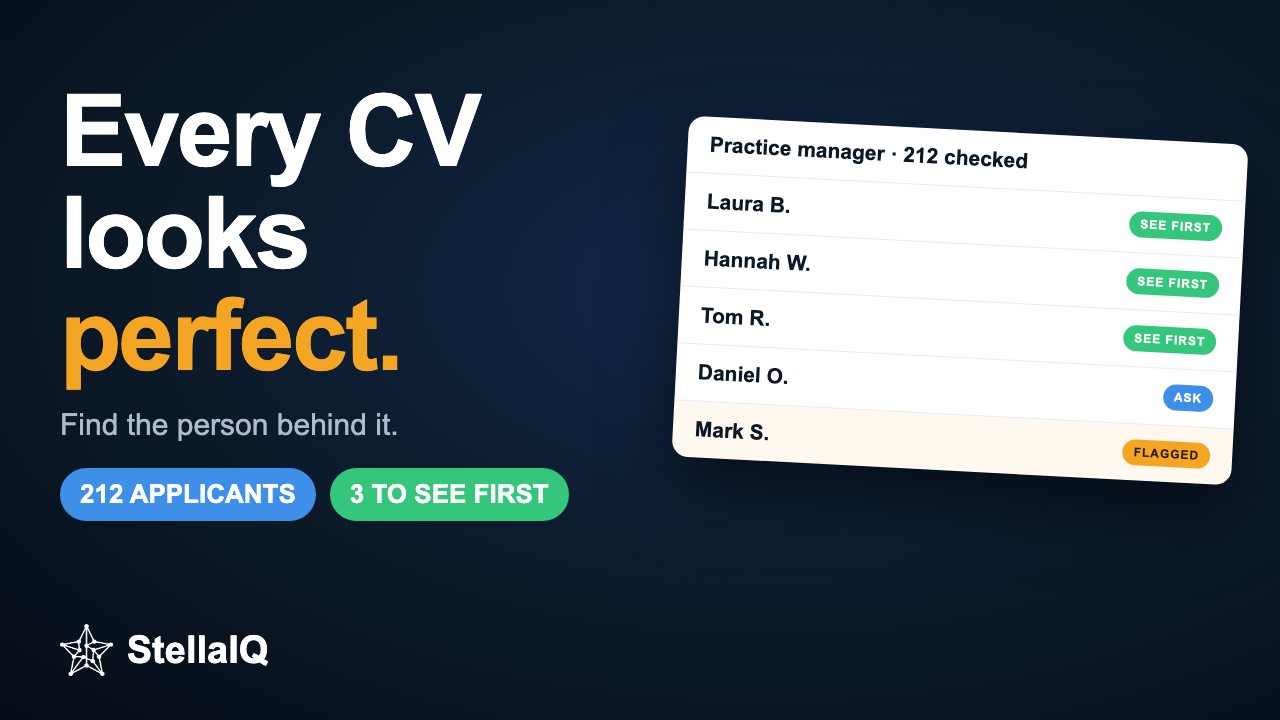
Screens illustrative; names and figures are examples. Plays from YouTube in privacy-enhanced mode, only when you press play.
Six steps, and a person stays in charge of the one that matters.
Live work scenarios are optional. They run with a specialist assessment partner inside the same flow, and the results land in your ATS with everything else.
Three screens from the Hiring Brain, following one role from start to finish. Names and details are made up for illustration.
Experienced practice manager. Sage expert.
Ran the office side of two law firms for eleven years. Set up Xero from scratch at both.
A partner is in court and a client is angry on the phone. What do you do in the next hour?
Her answer: rings the client back herself, agrees a next step, and briefs the partner at the end of the day.
Ran the office side of two law firms. In the live scenario she dealt with the court deadline first, then told the client when to expect a call.
Strong on billing and case management. Likes more process than your team uses. Worth asking about.
Set up an office from scratch. Her answers fit how your team works. One month's notice.
His CV says practice manager at three firms. His answers describe an office junior role. Check before you call.
Law firms, accountants and other professional firms, where a practice manager or HR manager does the hiring.
Agencies running Bullhorn, Vincere, JobAdder, Firefish, Mercury or a similar ATS.
The Hiring Brain suggests. People decide. Every shortlist is reviewed and every hiring decision is made by a person on your team.
Candidates are told AI is used. We build a short notice into your application process and your privacy information, so candidates know before any answer, scenario or CV is assessed.
The Hiring Brain runs in your own cloud account, under your own administrator access. Your data and your company profile stay yours. You remain the data controller under UK GDPR, and nothing in your Hiring Brain is used to train anyone else's model.
Culture fit means how your team works and what it values. It never means age, sex, ethnicity or anything else the law protects. Every ranking shows its reasons, and if a score cannot be explained, it does not get used.
Yes. There is no new system to learn. The Hiring Brain works inside the ATS or HR system you already use, through its API where there is one and its exports where there is not. Answers, scenario results and shortlists land where your team already looks.
Fixed prices, stated plainly, before you commit to anything.
We build your company profile, ask every applicant for that role the questions, and give you a shortlist with the reasons and the interview questions. Run it alongside your normal process and judge the shortlist for yourself.
Then one monthly plan, priced by how many roles you have open at once. It covers support and upkeep, the AI work on every applicant, and keeping your company profile up to date. A role counts while you are hiring for it. When it is filled or closed, the slot is free for the next one.
Most professional firms.
Larger firms and smaller agencies.
Recruitment agencies.
Priced to your volume.
Six-month minimum, billed monthly in advance. Live work scenarios are optional, charged per candidate when used. If your system needs unusual connection work, we quote it at a fixed price before we start. A discovery call costs nothing and is a conversation with the founder, not a salesperson.
The engine underneath is already in production in other sectors. For a national industrial services company, StellaIQ cut manual document processing time by roughly 80% across a fifteen-day build, reading paperwork automatically and filing it against the right job across an ERP, HubSpot and Microsoft 365. For an installer taking seventy appointments a day, handwritten sheets now go straight into the CRM, diary and sales spreadsheet: nothing typed, three to four hours a day given back.
Hiring is different (company profiles, applicant answers, CVs), but the engine is the same: learn how a business really works, read what arrives, and ask a person when the system is not sure.
We do not publish client names, and we will not publish yours either.
It is an AI system for hiring teams and recruitment agencies. It builds a profile of how your business really works, asks every applicant questions drawn from it, and checks their answers and CV against that profile. You get a shortlist that fits on skills and on culture, with the reasons beside each name. A person makes every hiring decision.
About your policies, your culture, the role and what makes it hard, real situations and how they were handled, well and badly, and why the last person left. It is a conversation with the people who do the hiring, and the profile is updated after every hire.
They answer a short set of questions built from your company profile, so the questions are about your business, not the usual ones they can rehearse. Shortlisted applicants can also work through live scenarios from the role, such as an urgent email or an angry client, so you see how they actually work.
No. The Hiring Brain ranks candidates and shows why. A person on your team reviews every shortlist and makes every decision. That keeps the judgement where it belongs, and it is what UK data protection law expects for decisions that matter to candidates.
Rankings are built from the role's real requirements and your company profile, and show their reasons for every candidate. Culture fit means how your team works and what it values. It never means age, sex, ethnicity or anything else the law protects. Rankings are checked against your own shortlists before they go live, and if a score cannot be explained, it does not get used.
No. Your team keeps working in the system it knows, whether that is Bullhorn, Vincere, JobAdder, Firefish, Mercury or the HR system you use in-house. Answers, scenario results and shortlists land in the fields your team already uses.
The Hiring Brain is built in your own cloud account, under your own administrator access. You remain the data controller under UK GDPR, nothing in it is used to train anyone else's model, and your existing retention rules still apply. Live work scenarios run with a specialist assessment partner under a data processing agreement, and we show you exactly what they see before you start.
Yes. Candidates are told AI is used before any answer, scenario or CV is assessed. We build a short notice into your application process and your privacy information, so nobody is surprised.
Employment law has already changed this year, and the next big change comes on 1 January 2027. From then, the qualifying period for unfair dismissal claims falls from two years to six months, and the cap on compensation is removed. A wrong hire becomes harder and more expensive to put right, so the checks before you hire matter more.
We start with a pilot on one live role. It begins with a conversation to build your company profile, then applicants are asked and checked as they come in. If you carry on after the pilot, the monthly plan starts.
We work with businesses between roughly £1m and £20m turnover. The test is simple: how many hours a week go on reading CVs, interviewing people who looked right on paper, and replacing hires who did not fit?
Forty-five minutes, no obligation. We will show you what the Hiring Brain would do with the role you are hiring for now.
Last updated
We'd like to use analytics and advertising cookies to see how people find this site. Nothing is set unless you agree. What we collect.