
StellaIQ builds an AI brain for your manufacturing business. It connects to the systems you already run — your ERP or MRP, the accounts, the CRM and the orders inbox — and puts an agent on every PC. Where is that order? Have we got the material? When can it ship? What did we quote them? Ask, and the answer comes straight back from your own data. And the orders that arrive by email and PDF are read into your ERP, so nobody has to retype them.
Because it arrives as a PDF, and your ERP needs it typed.
One customer's purchasing system sends a purchase order as a PDF. Another emails a few lines. A third sends a spreadsheet with their own part numbers on it. Someone in the sales office opens each one and types it into the ERP, line by line: the part, the quantity, the price and the date they want it. Then they check the price against what was agreed, send an acknowledgement and move on to the next one.
A manufacturer doing £10m with fifty staff usually runs an ERP or MRP system bought years ago, an accounts package, a shared orders inbox and a great deal of Excel. Each one works. Nothing passes anything to anything else, so people do the passing, and when a customer rings to ask where their order is, someone walks out to the shop floor to find out.
None of that is a technology failure. It is the cost of growing faster than the systems did, and it is paid every day in retyping, in mistakes that only show up when the wrong part ships, and in hours that nobody has budgeted for.
One brain connected to every system you run, and an agent on every PC that can ask it anything.
The brain stays connected to your systems and joins up what they hold — sales orders, works orders, stock and allocations, purchase orders, quotes, invoices and emails. Where a system allows live access it reads it live; where it only produces exports, it refreshes on a schedule you choose. Anyone can ask the agent on their PC a question in plain English and get the answer, with the record it came from. It only answers from your own data, and when it cannot find something it says so rather than guessing.
On works order WO-5521. The material is issued and machining is booked for Tuesday. Due to ship Thursday 3 December.
320 kg of 6082 aluminium bar in stores, and 280 kg of it is already allocated. Another 500 kg is due on Monday on PO-7712.
£12.40 each for 500, quoted on 4 November and valid for 30 days. Last year they paid £11.85.
£6,200 available on a £25,000 limit. Nothing is overdue.
Example questions and answers. Your agent answers from your own systems.
The agents also take work off your team: they read and reply to routine customer emails in your own tone of voice, file what comes in, and draft the chaser for an overdue invoice for someone to check and send. See how the AI brain works →
The brain reads every customer order as it lands, checks it against your ERP and raises it, so your sales office stops retyping.
Orders arrive in every shape: a PDF purchase order from a customer's buying system, an email with a few lines in it, a spreadsheet, and now and then a photo of a handwritten sheet. The brain reads each one as it lands in the orders inbox and picks out the customer, their order number and every line: the part, the quantity, the price and the date they want it.
Then it checks each line against your ERP. Is that our part number, or the customer's own? Is the price the one we agreed? Is the quantity sensible for this customer? Can we make it by the date they want, given our lead time? When everything agrees, the sales order is raised in your ERP and the acknowledgement goes back to the customer in your own wording. When something does not, the order waits for a person with the reason shown: an unknown part, a price that differs from the agreed one, or a date sooner than your lead time allows.
Customer part numbers are the usual snag. Once a person has matched a customer's part number to yours, the brain remembers it and only asks once. You decide how far it goes: it can raise clean orders straight away, or a person can approve each one with a single click to begin with. The first step is the two-day operations audit at £2,500 plus VAT, which shows exactly what it would take on your setup.
Most of what is sold as AI is automation with a better name, and the distinction matters because it changes what you should pay and what you should trust.
Checking a price against the agreed price list is a rule. Checking whether a date allows for the lead time is a comparison. Adding up what next week's jobs need against what is in stores is arithmetic. None of those need a language model, and putting one in front of them makes the job slower, more expensive and less certain — because rules are instant, cheap, auditable, and incapable of inventing an answer.
AI earns its place somewhere narrower: reading orders that arrive in forty different layouts, answering a question from your own material, and turning a day of exceptions into something a person can read in two minutes. We tell you which of your problems is which, and we do not sell you the expensive one when the cheap one works.
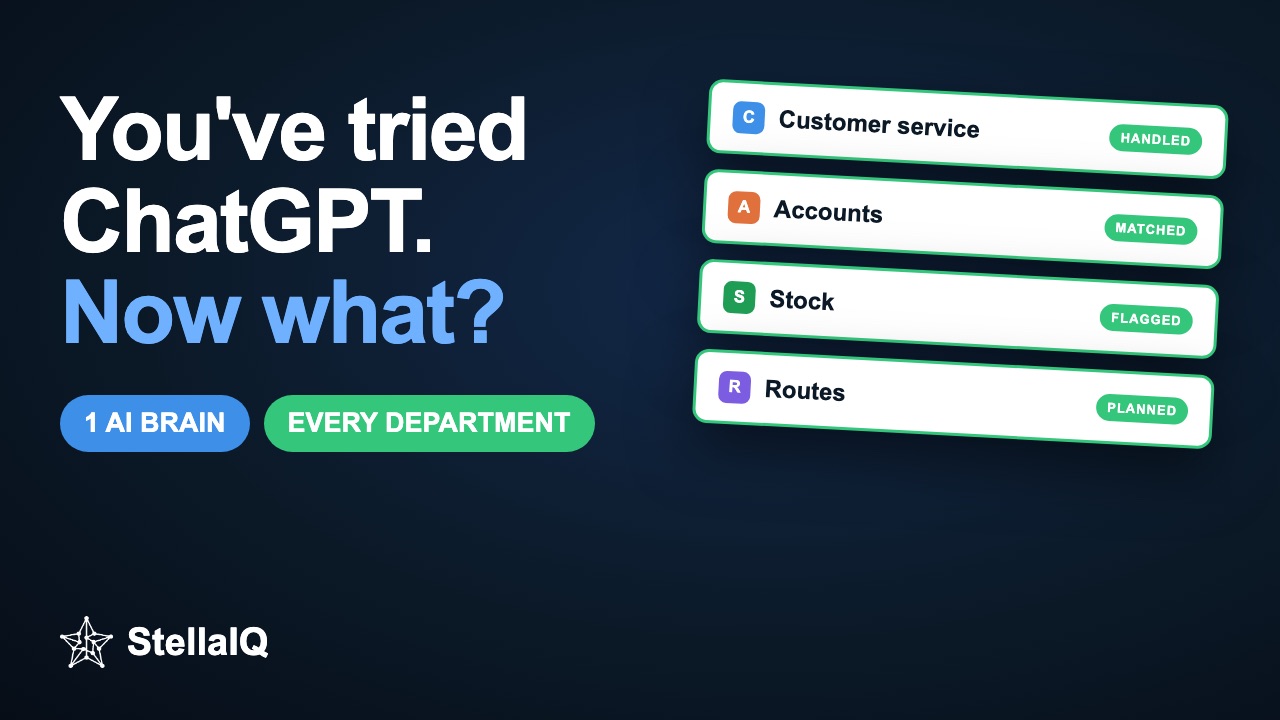
Everyone says use AI; nobody says where to start. This is one AI brain across a whole business: customer replies drafted, orders tracked, invoices matched, reorders flagged before you run out, and an assistant on every desk.
Screens illustrative; names and figures are examples. Plays from YouTube in privacy-enhanced mode, only when you press play.
The brain goes in first, connected to the orders inbox, the ERP, the accounts mailbox and the bank. Then it takes jobs off your team one at a time, starting with the orders. Each job is tested on your own documents and runs beside the way you work now until the two agree, and once the brain is doing it, anyone can ask about it from their PC.
The brain reads every order as it lands, whether it is a PDF, an email or a spreadsheet, checks each line against your ERP and raises the sales order. A person only looks at the orders that do not agree, with the reason already set out.
Ask it: “Which orders came in today, and which are waiting on a person?”
The brain sends each acknowledgement in your own wording, with the date your ERP gives. When a works order slips, it shows which customer orders are affected and drafts the update for someone to check and send, before the customer has to chase.
Ask it: “Which orders are due out this week and not finished?”
Every morning the brain checks the coming jobs against their bills of materials, what is in stores, what is already allocated and what is on order, and lists what you are short of, which jobs it hits and when the next delivery is due.
Ask it: “What are we short of for next week’s jobs?”
The brain reads every supplier invoice as it lands in the accounts mailbox and matches it to its purchase order and to what was received, checking the price, the quantity and any part delivery. A person only looks at the exceptions.
Ask it: “Which invoices don’t match their purchase order?”
The brain matches receipts from the bank to your sales invoices and keeps every customer’s account up to date. Monthly statements and reminders go out in your own wording, any customer can be held back, and your bookkeeper gets the allocations in the format they already use.
Ask it: “Has that customer paid, and what’s still open on their account?”
Delivery notes, proofs of delivery and certificates of conformity are read and filed against the right order, so anyone can pull them up in seconds, and any delivery with no proof that it arrived is flagged for someone to chase.
Ask it: “Send me the delivery note and certificate for order 10432.”
What the brain never does. It never changes a price or promises a date your system has not given: anything that differs from what was agreed goes to a person. It pays nobody: its access to your bank and accounts is read-only, and a person makes every payment. It does not replace your ERP or MRP, and you decide which messages go to customers on their own and which wait for a person. It shows, and a person decides.
Yes, and that is deliberate. Replacing an ERP in a £1m–£20m manufacturer is a six-figure project with a year of disruption attached. Automating around one is a fixed-price build measured in weeks. We would rather find out how much of the manual work disappears without touching the core system, and we will say so plainly if the honest answer is that the ERP itself is the constraint.
Manufacturers of this size typically run Sage 200, SAP Business One, Microsoft Dynamics 365 Business Central, Epicor, Syspro, MRPeasy or Katana, with Xero or Sage for the accounts, Microsoft 365 and a very large amount of Excel. Where a system has an API we use it. Where it does not — and plenty of older ERPs do not — we work with exports, database views or the file drops it already produces. An ageing system is not a blocker; it is just a different integration.
Fixed prices, stated plainly, before you commit to anything.
An operations audit costs £2,500 plus VAT. We spend time on site watching how the work is actually done rather than how it is described, and you get a ranked map of every opportunity with a figure against each one, an assessment of what can be integrated and what cannot, and a first build scoped at a fixed price. The audit stands on its own and belongs to you, whether or not you build anything with us afterwards.
A first automation build starts at £5,000 plus VAT. One workflow designed, built, deployed and handed over documented, with your team trained on it and thirty days of post-launch support included. A full engagement across several workstreams starts at £12,500 plus VAT. A discovery call costs nothing and is a conversation with the founder rather than a salesperson.
Everything is built in your own cloud account, fully documented, with administrator access from the first day. If you stop working with us, you keep the systems and the keys.
Two days on site, a ranked opportunity map with a value against each item, and a first build scoped at a fixed price.
One workflow built end to end, documented, with your team trained and thirty days of support.
Discovery, design and deployment across several workstreams.
The reading and matching on this page is the same work as our published case studies. For a national industrial services company, StellaIQ cut manual document processing time by roughly 80% across a fifteen-day build, by reading delivery paperwork automatically, filing it against the right job and routing only the exceptions to a person. Read the full case study. For an installer taking seventy appointments a day, the handwritten sheets are now read into the CRM, the diary and the sales spreadsheet with nothing typed, giving three to four hours a day back. See how that works.
We do not publish client names, and we will not publish yours either. What we will do on a discovery call is talk through the specific mechanics of that work — what was read, what was matched, what a person still checks and why — so you can judge whether the same thing applies to your operation rather than taking a logo on a page as evidence.
Anything your systems know: where an order is and when it is due to ship, what material is in stores and what is already allocated, when a purchase order is due, what was quoted and when, how much credit a customer has left. It answers from your own data and shows the record each answer came from.
StellaIQ builds this for UK manufacturers. The AI brain reads each order as it lands in the orders inbox, whether it is a PDF from the customer's purchasing system, an email or a spreadsheet, checks every line against your ERP (the part, the agreed price, the quantity and the date asked for) and raises the sales order without anyone retyping it. Anything that does not agree goes to a person with the reason. The first step is a two-day operations audit at £2,500 plus VAT.
Yes. Where a customer orders by their own part number, the brain looks it up against the cross-references you already hold. When it meets one it does not know, it asks a person once, remembers the answer and does not ask again.
No. The brain checks every price against what was agreed with that customer and every date against your lead times, and anything that differs goes to a person. It only ever gives a date your own system gives, and it never changes a price.
It sits on each PC as a simple dashboard, signed in with your team's existing work accounts, so there is nothing new to learn and nothing to change about how people already work.
The brain goes in first, on a server in your own Microsoft 365 or cloud account, and the orders inbox is connected straight away, so orders start being read as soon as your IT has given access. Each job it takes on is tested on your real documents, so order entry goes live once a few weeks of your own orders have been through it, and then runs beside your current method until the two agree. The audit that comes first takes two days on site, with a written report within ten working days.
Every job the brain takes on has its measures agreed before it starts and a baseline taken in the first weeks. For orders, that means how many were raised with nobody retyping them, how many needed a person and why, how long an order waited before it was acknowledged, and how many mistakes were caught before anything was made or shipped. We measure over the first twenty working days after go-live, and if a measure is missed we say why and what we will do about it.
Usually not, and we would rather prove it. Most of what costs you time sits in the gaps between systems rather than inside any one of them. If your ERP genuinely is the constraint we will tell you, but we will not lead with it.
No. Everything runs in your own cloud account, under your own administrator credentials, and nothing is used to train anyone else's model.
Most of what we build is not AI, it is rules, and rules do not guess. Where a model does read an order, every line is checked against something verifiable (the part exists, the price matches the agreed price, the date allows for your lead time) and anything uncertain is routed to a person. We do not give software authority to change a price, promise a date or pay a supplier.
We work with businesses between roughly £1m and £20m turnover. Below that the arithmetic rarely justifies a build; above it you probably have people whose job this already is.
The founder runs the audit and the build, on site. You are not handed to an account manager.
Forty-five minutes, no obligation, and you will get an honest answer about which of your problems is worth automating and which is not.
Last updated
We'd like to use analytics and advertising cookies to see how people find this site. Nothing is set unless you agree. What we collect.