
Appointment sheets, survey notes and job cards get photographed on a phone and sent to the office. StellaIQ reads them and fills in your CRM, your diary and your job system — in under a second, without anyone retyping a thing.
Usually: a photo, a group chat, and somebody in the office typing.
A canvasser books an appointment on a paper sheet. A surveyor writes up what they found. An engineer scribbles what they fitted and what still needs ordering. Then the phone comes out, the sheet gets photographed, and it lands in a WhatsApp group with thirty other photos.
Back at the office, someone opens that chat and starts typing. Into the CRM. Then the diary. Then the spreadsheet the sales manager actually looks at. Then the job system, so the installer knows where to go. The same six facts, typed four times, by a person who was hired to do something else.
Nobody chose this. It is what happens when the people producing the information are standing on a doorstep and the systems that need it are sitting on a desk.
Most of this job is not AI, and you should not pay for AI to do it.
Checking a postcode is valid, working out which installer covers that area, putting an appointment in a diary at the right time, flagging that a deposit has not been taken — that is arithmetic and rules. Rules are instant, cheap, auditable, and cannot invent an answer.
There is exactly one part of this that genuinely needs AI: reading the handwriting. A canvasser's scrawl at the end of a wet Tuesday is not something a rule can parse. That is where a model earns its place — and where it must be honest about what it cannot read. When the writing is unclear, our systems do not guess. They ask a person, and they wait.
A real appointment sheet, photographed and sent to a WhatsApp group. Watch what happens to it.
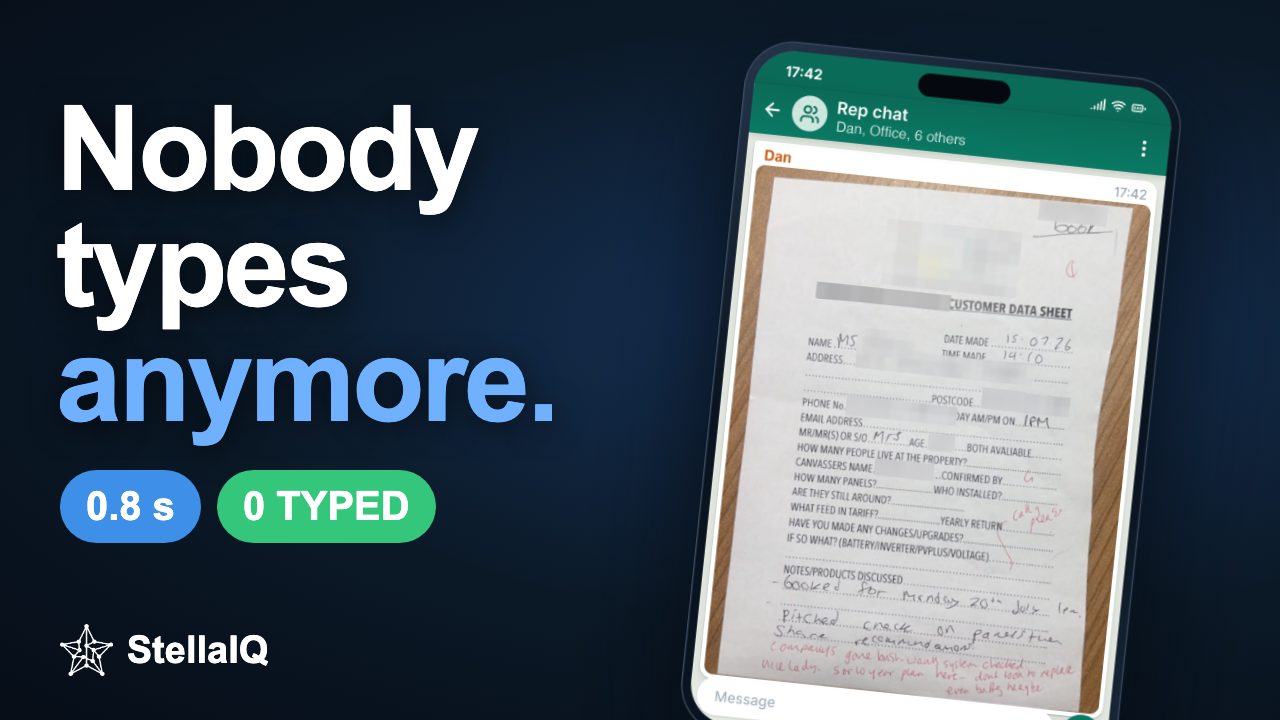
Real sheet, personal details masked. Plays from YouTube in privacy-enhanced mode, only when you press play.
Ranked by the hours they take back, not by what demos well.
A photo in the group chat becomes a lead in the CRM, an entry in the diary and a row in the sales spreadsheet. Unclear handwriting is flagged for a person rather than guessed at. Usually the biggest single win.
What the surveyor measured, photographed and recommended, turned into a structured record against the right job — instead of a phone full of pictures nobody can find in three weeks.
What was fitted, what was used, what still needs ordering, and the customer's signature — captured at the door and filed against the job the same day, not at the end of the week.
Quotes that have gone quiet surface automatically, with the history attached, so nobody has to remember to chase and no job is lost because a follow-up slipped.
What each job needs, ordered against the right supplier terms, with the confirmation matched back to the job rather than sitting in a shared mailbox.
Appointments allocated by area and availability, customers told when to expect someone, and exceptions raised the same day rather than discovered at the end of the month.
No, and that is the point. The team keeps doing exactly what it does now — writing on the sheet, photographing it, sending it to the same WhatsApp group. Nothing new to learn, nothing new to install on anyone's phone, no adoption problem to manage. The typing at the other end is what stops.
We meet a wide range of systems in this sector: field service and job management tools such as Commusoft, Simpro, Joblogic, ServiceM8 and Tradify; CRMs including HubSpot, Pipedrive and Salesforce; and Sage, Xero and Microsoft 365 behind them. Where there is an API we use it. Where there is not, we work with the exports and file drops the system already produces. An ageing system is not a blocker — it is a different integration.
Fixed prices, stated plainly, before you commit to anything.
An operations audit costs £2,500 plus VAT. We spend time with the people actually doing the work — the office staff typing, not just the directors — and you get a ranked map of every opportunity with a figure against each one, an assessment of what can be integrated and what cannot, and a first build scoped at a fixed price. The audit stands on its own and belongs to you.
A first automation build starts at £5,000 plus VAT. One workflow designed, built, deployed and handed over documented, with your team trained and thirty days of post-launch support. A full engagement across several workstreams starts at £12,500 plus VAT. A discovery call costs nothing and is a conversation with the founder, not a salesperson.
Everything is built in your own cloud account, fully documented, with administrator access from the first day.
Two days on site, a ranked opportunity map with a value against each item, and a first build scoped at a fixed price.
One workflow built end to end, documented, with your team trained and thirty days of support.
Discovery, design and deployment across several workstreams.
The business in the video takes seventy appointments a day. Every one used to be written on a sheet, photographed into a WhatsApp group, and then typed by hand into the CRM, the diary and the sales spreadsheet — three to four hours of somebody's day, every day.
Now the photo lands and the systems fill themselves in. Seventy a day. Nothing typed. Three to four hours a day given back. The field team never changed a thing about how they work.
We do not publish client names, and we will not publish yours either.
Then it asks. Anything it cannot read with confidence is flagged to a person with the photo alongside, rather than guessed at. A wrong appointment is far more expensive than a question.
No. They photograph the sheet and send it to the same WhatsApp group they use today. That is deliberate — adoption is where most field-team software dies.
A standard engagement runs fifteen days from kickoff to a working system. The audit before it is two days on site and a written report within ten working days.
Usually not. Most of the cost sits in the gaps between systems rather than inside any one of them. If your system genuinely is the constraint we will say so, but we will not lead with it.
Into your own cloud account, under your own administrator credentials. Nothing is used to train anyone else's model.
We work with businesses between roughly £1m and £20m turnover. The test is simple: how many hours a week does the office spend typing things the field team already wrote down?
Forty-five minutes, no obligation, and an honest answer about which of your problems is worth automating and which is not.
Last updated
We'd like to use analytics and advertising cookies to see how people find this site. Nothing is set unless you agree. What we collect.