
The StellaIQ AI brain connects to the systems you already run — your CRM, Xero or Sage, your stock control and the shared inbox — and puts an agent on every PC. Is that part in stock? When is it due in? What did we quote them? Have they got credit? Ask in plain English, and the answer comes straight back from your own data, with the record it came from.
Because the answer is spread across four systems.
A customer rings and asks whether something is in stock. The stock figure is in the stock system, the delivery date is in a supplier's email, the last quote is in the CRM and the credit limit is in the accounts. So someone checks one system, someone rings the warehouse, someone asks accounts — and the customer waits, or gets a guess.
It is the same in most businesses between £1m and £20m. A recruitment agency's answers sit in the CRM, a consultant's inbox and a spreadsheet. A law firm's sit in the case system and years of email. An installer's sit in the diary, the job sheets and a WhatsApp group. Each system works. Nothing passes anything to anything else, so people do the passing, and what the business knows ends up in a few people's heads.
Anything your systems know. One brain is connected to all of them, and an agent on every PC can ask it in plain English.
The brain stays connected to your systems and joins up what they hold — orders, stock, purchase orders, quotes, invoices and emails. Where a system allows live access it reads it live; where it only produces exports, it refreshes on a schedule you choose. Anyone can ask the agent on their PC a question and get the answer in seconds, with the record it came from. It only answers from your own data, and when it cannot find something it says so rather than guessing.
38 in the main warehouse and 12 at the trade counter. 30 are already allocated to open orders.
On purchase order PO-20931, confirmed by the supplier for Thursday 2 October.
£4,180 on 12 September, valid until 12 October. They have not replied yet.
£2,300 available on a £10,000 limit. One invoice is fourteen days overdue.
Example questions and answers. Your agent answers from your own systems.
The same works in any business: which candidates have we already sent this client, what did we agree on this matter, which jobs are booked for Thursday and which are still waiting for a signed quote.
By only answering from your own data, and by showing its working. Every answer comes with the record it came from — the order, the purchase order, the email — so anyone can check it. When the brain cannot find something, it says so rather than guessing.
The numbers are not written by a language model. Stock levels, credit available and totals are calculated by rules, which are instant, auditable and incapable of inventing an answer. The AI does the parts that need it: understanding the question however it is phrased, reading messy documents and emails, and writing the answer in plain English.
A simple question, and in most businesses the answer is split across the CRM, the sales spreadsheet, the accounts and someone’s inbox. This is what it looks like when you ask it once, in plain English, and get the answer in seconds — every line traceable to the record it came from.
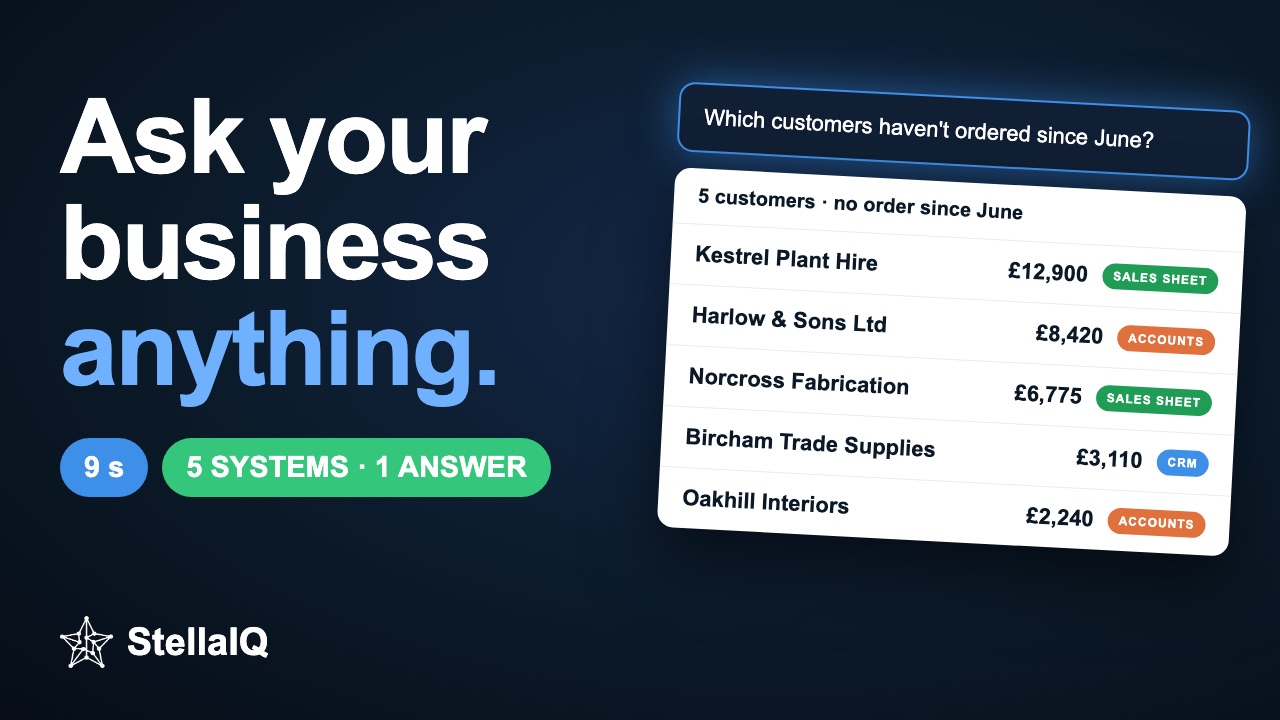
Screens illustrative; names and figures are examples. Plays from YouTube in privacy-enhanced mode, only when you press play.
Answering questions is the start. The same agents take the repetitive work off your team, and leave anything that matters for a person to check.
Incoming customer emails are read, sorted and answered in draft in your own tone of voice, ready for someone to check and send.
Delivery notes, certificates and paperwork are read and filed against the right job or account, with only the exceptions routed to a person.
A photographed job sheet or an order in an email is read and entered into every system it belongs in, without anyone retyping it.
Supplier statements, invoices and purchase orders are matched line by line, and only the mismatches are left for a decision.
The chaser for an overdue invoice or an unanswered quote is drafted with the right figures, for someone to check and send.
Yesterday's exceptions — late deliveries, unmatched invoices, quotes about to expire — turned into something a person can read in two minutes.
The ones you already have. Nothing is replaced, and your team keeps working the way it does now. The systems we meet most often are Xero, Sage 50 and Sage 200, QuickBooks, HubSpot and other CRMs, SAP Business One, Cin7, Unleashed, Microsoft 365 (Outlook, Excel and SharePoint) and a great many spreadsheets.
Where a system has an API we use it. Where it does not — and plenty of older systems do not — we work with exports, database views or the file drops it already produces. An ageing system is not a blocker; it is just a different connection.
Fixed prices, stated plainly, before you commit to anything.
It starts with an operations audit, which costs £2,500 plus VAT. We spend two days on site finding where the answers in your business actually live and which questions cost your team the most time. Within ten working days you get a written report: what the brain would connect to, what it could answer, and a first build scoped at a fixed price. The audit stands on its own and belongs to you, whether or not you build anything with us afterwards.
A first build starts at £5,000 plus VAT and runs fifteen days from kickoff to a working system, with your team trained and thirty days of support included. A full engagement across several workstreams starts at £12,500 plus VAT. A discovery call costs nothing and is a conversation with the founder rather than a salesperson.
Everything is built in your own cloud account, fully documented, with administrator access from the first day. If you stop working with us, you keep the brain and the keys.
Two days on site and a written report within ten working days: what the brain would connect to, what it could answer, and a fixed-price first build.
A working brain on your first systems in fifteen days, with your team trained and thirty days of support.
The brain across several systems and workstreams, with the agents taking on the repetitive work.
For a national industrial services company, StellaIQ cut manual document processing by roughly 80% in a fifteen-day build, by reading delivery paperwork automatically, filing it against the right job and routing only the exceptions to a person. Read the case study.
For an installer taking seventy appointments a day, every sheet used to be photographed into a WhatsApp group and typed by hand into the CRM, the diary and the sales spreadsheet. Now the photo lands and the systems fill themselves in: nothing typed, and three to four hours a day given back. See how that works.
We do not publish client names, and we will not publish yours either.
An AI brain is a system that connects to the software a business already runs — its CRM, accounts, stock control and email — so that anyone can ask questions about the business in plain English. StellaIQ's version puts an agent on every PC and answers only from the business's own data, showing the record each answer came from.
The ones you already have: Xero, Sage, QuickBooks, HubSpot and other CRMs, SAP Business One, Cin7, Unleashed, Microsoft 365 and spreadsheets. Where a system has an API we use it; where it does not, we work with its exports or file drops. Nothing is replaced.
It sits on each PC as a simple dashboard, signed in with your team's existing work accounts, so there is nothing new to learn and nothing to change about how people already work.
It only answers from your own data and shows the record each answer came from. When it cannot find something it says so rather than guessing. Figures such as stock levels, credit available and totals are calculated by rules, not written by a language model.
No. You decide who can ask about what — for example, credit limits only for the accounts team — and the brain keeps to it.
Nowhere new. Everything runs in your own cloud account, under your own administrator credentials, and nothing is used to train anyone else's model.
The audit takes two days on site, with a written report within ten working days. A first build runs fifteen days from kickoff to a working system.
An operations audit costs £2,500 plus VAT. A first build starts at £5,000 plus VAT, and a full engagement across several workstreams starts at £12,500 plus VAT.
No. It works for any business between roughly £1m and £20m turnover whose answers are spread across several systems: wholesalers and distributors, installers, recruitment agencies, law firms, manufacturers and industrial services.
Forty-five minutes, no obligation. Bring the question your team spends longest chasing, and you will get an honest answer about whether the brain can answer it.
Last updated
We'd like to use analytics and advertising cookies to see how people find this site. Nothing is set unless you agree. What we collect.